How a Market Place Becomes a Town Center
How a market place becomes a town center: see how repeated visits, nearby services, and permanent buildings can turn a meeting point into a shared local hub.
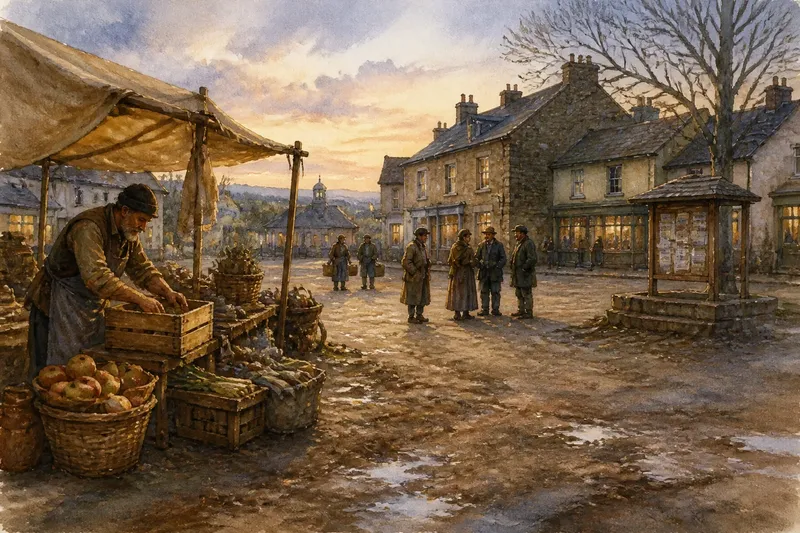
How does a market place become a town center? A stallholder packing up at dusk leaves an open patch of ground behind, but the people who met there may return for other reasons. In northern settlements, that repeated use can give a market place a lasting role without a single plan to make it the center.
The change is less about a busy day than about what happens between market days. People learn where to meet, which routes lead there, and what other errands can be done nearby. A familiar gathering point can gradually become a place for trade, services, and local decisions.
Repeated visits make a market place a town center
A market may begin as a regular occasion rather than a permanent district. Sellers bring goods, and people arrive from nearby homes or more distant settlements. The gathering could take place on a market day, during a seasonal event, or alongside another local activity.
Trade is only part of the draw. Visitors may meet neighbors, arrange a repair, pass along news, or find out when a service will be available. As people come to expect others at a particular green, widened street, or open space beside a route, the location becomes an easy shared reference point.
That expectation matters because it makes each visit useful in more than one way. A person who comes to exchange goods may also deliver a message or arrange a future appointment. The market place starts to function as a meeting point even for people who do not buy or sell anything.
Nearby services give the gathering point ordinary uses
Once a location is familiar, other activities may settle close to it. A repairer can work near the market because customers already pass through. A trader may keep storage nearby rather than carry goods in and out. A meeting room, place of worship, notice point, or administrative office may also draw on the same pattern of visits.
These activities reinforce one another. Someone visiting a shop might arrange a repair; a person attending a meeting might stop for supplies. The result is not necessarily a planned center. It is a cluster of useful destinations that makes a familiar place worth visiting on ordinary days.
Buildings make the shift visible, but they do not settle the question by themselves. A row of shops is not automatically a shared center if residents continue to organize daily life elsewhere. A modest place with few permanent buildings may function as one if people reliably use it to meet and coordinate practical needs.
Settlement patterns and routes shape the market's reach
In northern regions, homes may be scattered across fields, water, woodland, or sparsely occupied land. A regular meeting point can bring several local catchments together, but its reach depends on how people get there and what they can do once they arrive. A market beside a route linking settlements has a different position from one that is difficult to reach or disconnected from everyday destinations.
A gathering beside an existing cluster of homes starts with nearby residents who can use services between market days. A market in an open area beyond the main settlement may remain periodic unless homes, workplaces, or institutions develop close enough to support routine visits.
Nor does one market necessarily become the center for every part of local life. Trading may gather in one place while work, worship, schooling, or civic activity remains elsewhere. A town center is a concentration of functions, not a rule that all local activity must share one address.
Permanent buildings anchor a familiar meeting place
Temporary stalls disappear when the gathering ends. A permanent shop, workshop, hall, or service building gives people a reason to return at other times and provides a recognizable point for directions. Residents can say to meet by the hall even when there is no market underway.
Say a scattered parish has a weekly produce market beside an existing cluster of houses. A repairer opens a workshop near the market, and a room in the cluster becomes the usual place for notices and meetings. Visitors now have several ordinary errands there, so the market ground and nearby streets become a more regular focus. The observable change is that people use the same location for unrelated tasks, not merely that new buildings have appeared.
The process can stall if visitors have little reason to return between market days or if useful services are already established in another settlement. New premises alone do not make a durable center. What matters is whether activities depend on the shared location enough to keep bringing people back.
Several kinds of evidence show whether a market shaped a town center
- If an open space sits beside routes that connect nearby settlements, then its position could support a gathering point; if the routes bypass it, look for another reason people meet there.
- If shops or services cluster around the former market ground, then the old gathering may still shape the center; if they concentrate elsewhere, treat the market's influence as limited or historical.
- If people use the area for errands and meetings between market days, then it functions as an everyday center; if activity appears only during the market, it remains mainly a periodic destination.
- If a hall, workshop, or place of worship shares the same local cluster, then overlapping uses may help sustain visits; if each function sits apart, do not assume they form one center.
- If street names or local records refer to a market, then they offer a clue about past use; if no such clue exists, rely on the current layout and other evidence rather than inferring a market origin.
- If nearby housing supports regular visits, then permanent services have a local base; if homes are distant and access is awkward, consider whether another route or settlement is the stronger focus.
What questions help explain how a market place becomes a town center?
Does every market become a town center?
No. A market may remain a periodic gathering if it does not support regular services, nearby settlement, or other shared activities. Its wider role depends on what people do around the site between market days.
Why do services gather near an old market?
A market brings people to a known location, giving nearby providers a chance to reach visitors from more than one part of the surrounding area. The location may also be easy to find and convenient for combining errands.
Can a town have more than one center?
Yes. Different areas can serve different routines, such as shopping, civic business, or access to local services. “Center” can describe a practical concentration of activity rather than one point used by everyone.
How can I tell whether a market still shapes a town center?
Look at where shops, services, meeting places, and everyday errands cluster now, then compare that pattern with the former market space. Street names and open spaces can suggest past use, but current activity shows how the settlement functions today.
Do not treat a central square as proof of a market origin
A central-looking square does not, by itself, establish that a market started the town. The space may have served another purpose, or a market may have moved into a place that was already important. It is not worth the effort to infer a settlement's full history from one open space or an old street name alone.
For anyone asking how a market place becomes a town center, the useful clues are the sequence of uses, the routes that bring people there, and the activities that continue between gatherings. A market may fade while nearby shops and meeting places retain its central role; elsewhere, the market survives as the town's everyday focus. The distinction is visible in what people repeatedly do there now.