A Walk That Starts with Street Names
A street-name walk turns a familiar neighborhood into a closer read, with simple ways to spot patterns without treating guesses about origins as facts.
How do you make a familiar neighborhood feel newly readable without researching every street? Try a street-name walk: follow the names on signs, note where they repeat or change, and treat their possible origins as questions rather than answers. The point is not to solve the map. It is to notice what the map is already saying.
What is a street-name walk?
It is an ordinary walk organized around a small act of attention. Instead of choosing a destination, choose a naming pattern: trees, local surnames, numbers, compass directions, trades, or words that seem to belong to the same theme. Then see where that pattern appears and where it gives way to something else.
Street names are useful because they sit at the meeting point of language and movement. They label routes people use every day, but they also preserve choices made by whoever named or renamed them. A sign can prompt a question; it cannot, by itself, settle the answer.
Keep the walk modest. A few connected blocks are enough to reveal a cluster, a break, or an odd exception. If you make the outing into a grand search for the neighborhood’s entire past, the walk can become a research assignment with inconvenient shoes.
How do you choose a naming pattern?
Start with what is visible on nearby signs rather than selecting a theory in advance. At a familiar corner, look at the names of the streets ahead and around you. Do several refer to plants, birds, professions, numbers, or people? Is one name noticeably different from its neighbors?
Pick a pattern broad enough to produce comparisons but narrow enough to keep your attention. “Names connected with nature” may offer more to notice than a search for one particular flower. “Names that sound directional” could include North, East, Upper, or Lower, while leaving room to ask whether those words still describe the streets as a walker experiences them.
- Repeated words: Look for the same surname or descriptive term on more than one street.
- Related subjects: Notice whether several names suggest plants, animals, occupations, or local features.
- Numbering: See whether numbered streets run in a sequence, skip a number, or change direction.
- Directional terms: Compare names such as North Road or Upper Street with the layout they label.
- Exceptions: Watch for one name that interrupts an otherwise consistent cluster.
These are prompts, not categories the neighborhood must obey. Names may reflect different naming decisions, and a tidy-looking group does not prove that every street belongs to one plan.
What should you notice as the names change?
Notice where a pattern starts, where it stops, and what sits near the boundary. A group of tree names might thin out near a main road; a set of surnames might occupy several side streets before a single numbered avenue appears. Record the sequence in plain language, such as “three related names, then a different one,” rather than supplying an explanation too quickly.
Also notice how the name meets the route. Does it appear on a short street, a long through-road, a dead end, or a crossing? Does the sign use a familiar spelling while a nearby sign uses another? These details are observations about the walk, not evidence of why the street received its name.
A small notebook or a notes app can help. Write down the street name, the nearest intersection, and what drew your attention to it. If you take photographs, capture the sign in context where it is safe and permitted; a close-up without a corner or landmark can be hard to place later. There is little value in photographing every sign. A handful that shows a contrast is easier to review.
How can you separate a pattern from a guess?
Keep three kinds of notes distinct: what the sign says, what you observe about its neighbors, and what you wonder about its origin. “Maple Street is beside Ash Avenue” is an observation. “The names seem to form a tree cluster” is a cautious interpretation. “The streets were named after trees that grew here” is a historical claim, and it needs evidence beyond the names themselves.
Names can be inherited, changed, reused, or chosen for reasons that are not obvious from the pavement. A surname may refer to a person, but the sign alone may not tell you which person. A name that sounds descriptive may have become detached from the feature it once described, or may never have described it at all. Even a sequence that looks deliberate can invite more certainty than the evidence allows.
For a low-key walk, it is perfectly reasonable to leave questions open. If one detail matters to you, compare a current street map with a local directory, municipal naming record, or historical map held by a library or local archive. Those sources may help distinguish a documented account from a plausible guess. Follow the source’s wording and scope rather than turning an uncertain explanation into a neat origin story.
Where should you walk, and what should you bring?
Choose streets you can reach comfortably and follow without rushing. A compact residential area, a grid with numbered streets, or a small group of roads with related names can all work. In a northern town, names tied to trees, landforms, local languages, or directional terms may stand out, but no naming theme belongs to every place. Let the signs in your own neighborhood set the subject.
Bring a phone or pocket notebook, and use a map only as a reference for finding street labels and intersections. Keep your attention on public paths and ordinary pedestrian safety: obey crossings, avoid stepping into a roadway for a better view, and respect private property. Local access rules and posted signs take precedence where they apply.
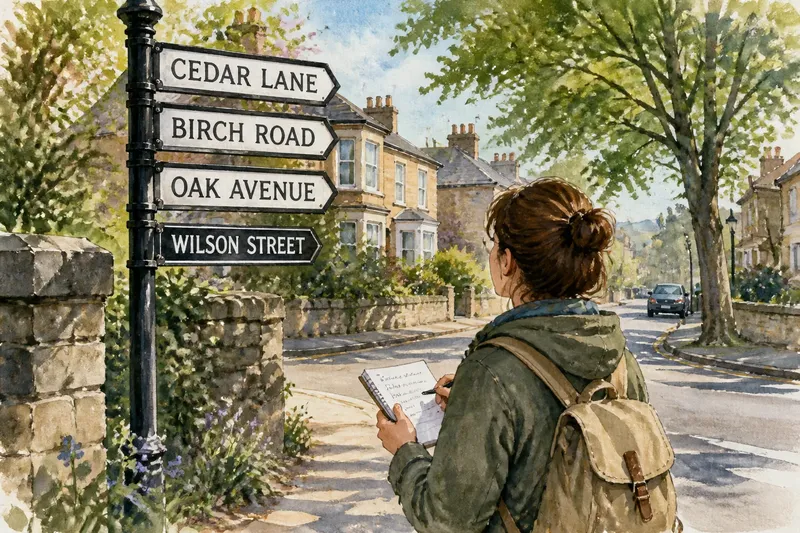
Say you notice Cedar Lane, Birch Road, and one nearby street named for a family. You could walk the block, note which names cluster together, and mark the family name as an interruption rather than deciding that it marks an old boundary. The observable result is a clearer record of the naming pattern and its exception; the reason for the change remains an open question.
Which questions help make sense of street names?
Do street names reveal a neighborhood’s history?
They can offer clues and questions, but a name alone rarely establishes a full history. Treat it as a lead to check against maps, local records, or other reliable sources.
Why do several nearby streets share a theme?
A group may reflect a naming convention, a shared reference, or decisions made at different times. The visible cluster is something you can describe; its cause needs separate evidence.
Can I use a map app for this walk?
Yes, if it helps you locate street names and keep the route legible. Check labels against the signs you see, since map labels can omit details or display a different form.
What if the name has several possible meanings?
Write down the possibilities without choosing one unless a dependable local source supports it. Uncertainty is not a flaw in the walk; it is a useful limit on what the sign can tell you.
How can you keep the walk easy?
Set one question and let the route answer only what it can. You might ask where a cluster ends, whether a repeated word appears in several forms, or which streets interrupt a numbered sequence. Stop when the pattern is clear enough to describe, not when every name has been explained.
What is not worth the effort is turning each unfamiliar name into an online search while standing at the corner. That pulls attention away from the street and tends to reward the first plausible explanation. Make a short list of questions for later instead.
When you get home, sketch the route or mark a few signs on a map. Include the pattern you noticed and any exceptions, then label uncertain ideas as questions. A street-name walk works best as a way to read familiar ground more closely: the names provide a trail of observations, while the gaps keep the story honest.